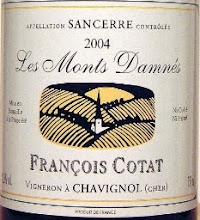
I guess his mom forgot to tell Uncle Bob that he should not post on the web when he's drunk...
Another precious, priceless one liner from his Majesty. This is what he posted after having diner at a Philly restaurant last week:
Parker quote
Wine expert Robert Parker showed up at Bibou, the well-regarded French BYOB in South Philly, last night.
Parker posted this:
•Marcassin Estate chardonnay 2000
•Leuwin Estate 2004 chardonnay
•Guigal 1990 white Hermitage
•Dagueneau 2006 Silex
•Beaux Freres 1994
•Haut Brion 1982
•Vina Tondonia 1976
•Catena Alta 1997 Malbec
•Rostaing 1991 Cote Rotie La Landonne
•Guigal 1991 La Landonne
•Guigal 1985 and 1988 La Mouline
•Guigal 1989 La Landonne
•and a few others
"I loved everything about this place...the quality of the food alone merits a must visit," he wrote. "Add the BYO and no corkage....and better yet...no precious sommelier trying to sell us some teeth enamel removing wine with acid levels close to toxic, made by some sheep farmer on the north side of his 4,000-foot foot elevation vineyard picked two months before ripeness, and made from a grape better fed to wild boar than the human species....we all know the type-saving the world from drinking good wine in the name of vinofreakism.
Ha ! Isn't beautiful? here's uncle Bob giving us lessons on what we should drink.
What do we learn here?
- if you love acidity in your wines, you suck
- if you dare drinking wines that Bobby do not like, you suck
- if you think differently than Bobby, well you still suck
- if you are a sommelier, well you're precious and yes you also suck (you have to love the description of sommelier when you see the kind of wines he drinks...anyway...)
- if you're not Bob, you suck. Period.
When you're a "public" figure, I believe there are things you must not say. We have here a perfect example of someone who feels threaten by all the changes in the wine world and who is losing his authority.
I just can't accept being insulted because I don't have the same tastes. How old is he? 5 ? Coming from someone who has been preaching for diversity in wine that's laughable.
A funny coincidence is that yesterday I was reading an interview of Pascal Delbeck, who knows a thing or two about wines, after being in charge of Ausone for more than 20 years. In this interview, Mr Delbeck makes a very pertinent note:" Mr Parker has a simple taste, very simple taste. So easy that all the oenologues who have money and common sense can make a wine to please him and exploit his taste".
Vive la difference.
I don't have anything to add.
Wednesday, September 29, 2010

Sunday, September 26, 2010
Ladybug, ladybug...what ladybug?!
Ok, I guess you know what's coming....2004 Burgundy. Whenever there's something wrong in a 2004 Burgundy, it has to be the ladybug. It's vegetal? well it's because of the ladybug. It sucks? well it's again because of the ladybug..
There has been much discussions about the vegetal, green aspects a lot of 2004 Burgundies showed. I think this has influenced, maybe unconsciously, many people and whenever they were drinking, they were actually looking for a greenness in the wine. And if there was one, well it could not be because of a lack of ripeness or anything else. I have to admit that 99% of the 04 Burgs I had were all pretty good. Only average was a Voillot Volnay VV which decided to never open. So much for that ladybug.
Even talking to Clive about it, it seems like it was not really a big issue. Maybe it was US-centric as I also never really read anything about it in the French magazines.
Anyway, everybody is free to its own opinion of this topic and as long I can keep finding crazy deals of closed out Burgs, I could not care less.

So this week, I had a lovely 2004 Roumier Chambolle Musigny. This wine kept getting better over 4 days and showed a beautiful Chambolle character. Balanced, very floral with nice red fruits with a dash of darker fruit as well. Good acidity with the oak being more and more integrated every day. This will be really cool for the mid term drinking.
Maybe the ladybugs never found their way to Christophe's vineyards.... :-)
There has been much discussions about the vegetal, green aspects a lot of 2004 Burgundies showed. I think this has influenced, maybe unconsciously, many people and whenever they were drinking, they were actually looking for a greenness in the wine. And if there was one, well it could not be because of a lack of ripeness or anything else. I have to admit that 99% of the 04 Burgs I had were all pretty good. Only average was a Voillot Volnay VV which decided to never open. So much for that ladybug.
Even talking to Clive about it, it seems like it was not really a big issue. Maybe it was US-centric as I also never really read anything about it in the French magazines.
Anyway, everybody is free to its own opinion of this topic and as long I can keep finding crazy deals of closed out Burgs, I could not care less.

So this week, I had a lovely 2004 Roumier Chambolle Musigny. This wine kept getting better over 4 days and showed a beautiful Chambolle character. Balanced, very floral with nice red fruits with a dash of darker fruit as well. Good acidity with the oak being more and more integrated every day. This will be really cool for the mid term drinking.
Maybe the ladybugs never found their way to Christophe's vineyards.... :-)
Monday, September 13, 2010
A few biodynamic wines
While we're enjoying some time off in Southern California, we spent 4 days in San Francisco. I love this city and during our stay I bought a few wines to drink while in Newport Beach. For the 1st time, we went to San Francisco Wine Trading Company. I would really recommend anyone to stop there. Friendly staff and great selection for Provence and Languedoc especially.

Anyway, somehow, the 1st 3 wines we drunk were all issued from biodynamic wineries and were all great wines.

The 1st wine was a wonderful 2001 Marcel Deiss Burlenberg Pinot noir. Grown on limestone soil, this pinot would trick any blind taster and will lead you to Burgundy. I'm usually not a fan of Alsatian pinot noir except for the René Muré Clos St Landelin and this Deiss. There's a great spiciness with an impressive volume on the palate. Bright sherry with some blood orange. Mineral and long, this is drinking really well.
Then, we moved to the 2007 Clos Marie, Coteaux du Languedoc Pic St Loup, Cuvée Manon. Located just north of Montpellier, Christophe Peyrus farms in vineyards biodynamically. Made with typical southern grapes with a majority of grenache blanc (40%) and roussanne (30%) completed with clairette, maccabeu and carignan blanc. Raised in barrels, this shows a perfect balance and the wood is now completely integrated. Lovely nose with lemon, pear and mandarin. Hint of anise mixed with floral notes. Slightly nutty as well. Touch of fresh butter. Fat on the palate but with a surprising acidity and freshness. Only 12.5%. The most surprising thing in this wine is the incredible freshness. I was impressed. Bravo !
To finish our biodynamic journey, a superb 2008 Bott-Geyl Riesling Les Elements was sacrificed. Started very steely and mineral on the nose. Very lemony with grapefruit and floral notes with a touch of petrol. Very enjoyable nose. Almost dry, soft with very good acidity. Green apple. It's a little simple on the palate right now. Really easy to drink. Very nice wine.
While biodynamic practices do not assure great wines, this was the case here. Careful and thoughtful winemaking leading to balanced and low alcohol wines.

Anyway, somehow, the 1st 3 wines we drunk were all issued from biodynamic wineries and were all great wines.
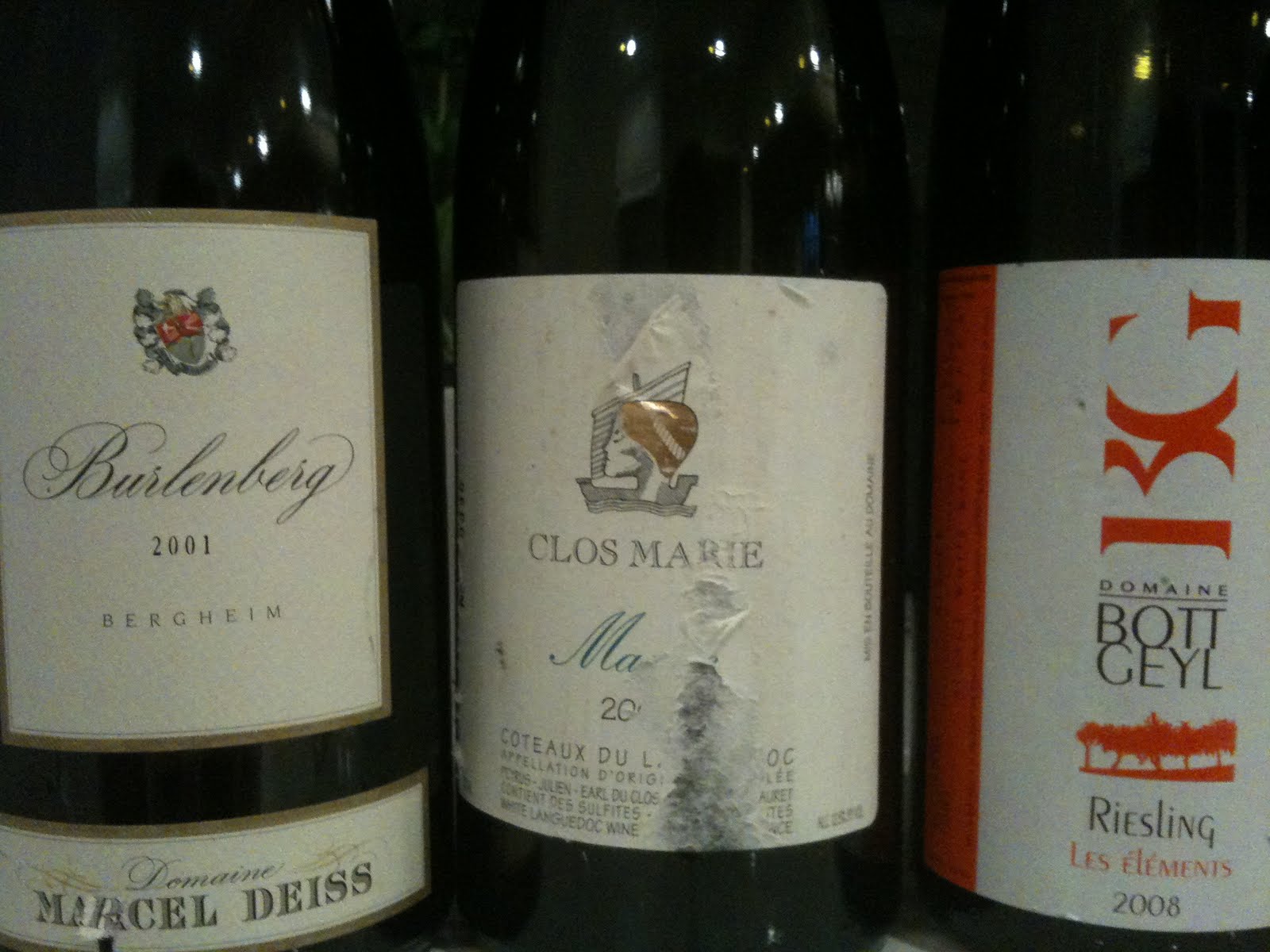
The 1st wine was a wonderful 2001 Marcel Deiss Burlenberg Pinot noir. Grown on limestone soil, this pinot would trick any blind taster and will lead you to Burgundy. I'm usually not a fan of Alsatian pinot noir except for the René Muré Clos St Landelin and this Deiss. There's a great spiciness with an impressive volume on the palate. Bright sherry with some blood orange. Mineral and long, this is drinking really well.
Then, we moved to the 2007 Clos Marie, Coteaux du Languedoc Pic St Loup, Cuvée Manon. Located just north of Montpellier, Christophe Peyrus farms in vineyards biodynamically. Made with typical southern grapes with a majority of grenache blanc (40%) and roussanne (30%) completed with clairette, maccabeu and carignan blanc. Raised in barrels, this shows a perfect balance and the wood is now completely integrated. Lovely nose with lemon, pear and mandarin. Hint of anise mixed with floral notes. Slightly nutty as well. Touch of fresh butter. Fat on the palate but with a surprising acidity and freshness. Only 12.5%. The most surprising thing in this wine is the incredible freshness. I was impressed. Bravo !
To finish our biodynamic journey, a superb 2008 Bott-Geyl Riesling Les Elements was sacrificed. Started very steely and mineral on the nose. Very lemony with grapefruit and floral notes with a touch of petrol. Very enjoyable nose. Almost dry, soft with very good acidity. Green apple. It's a little simple on the palate right now. Really easy to drink. Very nice wine.
While biodynamic practices do not assure great wines, this was the case here. Careful and thoughtful winemaking leading to balanced and low alcohol wines.
Friday, September 3, 2010
Selosse and Huet: masters of their domain
To start my Bday dinner, my wife prepare some pasta dough and created some Lemon ravioli. This is a great dish and we needed 2 whites to go along. A friend brought the 1996 Huet Le Mont Sec and I opened a Selosse Initiale (disgorged nov 2007).

I was super excited to try an aged Huet as all the ones I had were only 2 to 4 years old. This turned out to be a great experience. The Huet showed a rich nose with honey, pumpkin, quince with hint of flint. Dry, borderline of having a touch of RS, the high acidity gives the wine plenty of energy in spite of its fatness. Lemony honey with the slightest hint of oxidation. What I loved was the Chenin character.
The Selosse, as always was a unique experience. This bottle was more oxidative than the last one I had. The nose was stunning and complex. The oak is so well used. You feel like drinking a white Burgundy (with a hint of Jura in this bottle !). There's a strong minerality associated with ripe fruits.
Both wines were perfect with the lemon raviolis. But even more interesting maybe was that the 2 wines showed similar characteristics: oxidative notes, richness, high acidity and minerality. I would not have thought about it before but the luck of drinking those 2 wines side by side opened my eyes.
I will always keep learning....

I was super excited to try an aged Huet as all the ones I had were only 2 to 4 years old. This turned out to be a great experience. The Huet showed a rich nose with honey, pumpkin, quince with hint of flint. Dry, borderline of having a touch of RS, the high acidity gives the wine plenty of energy in spite of its fatness. Lemony honey with the slightest hint of oxidation. What I loved was the Chenin character.
The Selosse, as always was a unique experience. This bottle was more oxidative than the last one I had. The nose was stunning and complex. The oak is so well used. You feel like drinking a white Burgundy (with a hint of Jura in this bottle !). There's a strong minerality associated with ripe fruits.
Both wines were perfect with the lemon raviolis. But even more interesting maybe was that the 2 wines showed similar characteristics: oxidative notes, richness, high acidity and minerality. I would not have thought about it before but the luck of drinking those 2 wines side by side opened my eyes.
I will always keep learning....
Sunday, August 29, 2010
The king of Provence
The very 1st time I had a Trevallon it was a revelation: depth, elegance and complexity. All of this is too rare in Provence.
Trevallon is located in the heart of Provence in Saint-Etienne-du-Grès, in the Bouches-du-Rhône, 25 km south of Avignon and 7 km west of Saint-Rémy-de-Provence (beautiful village), on the northern slopes of the Alpilles. The vineyard covers 17 hectares: 15 hectares of red grapes, made up of equal parts of Cabernet Sauvignon and Syrah. Plus 2 hectares of white grapes, 45 % Marsanne, 45 % Roussanne and 10 % Chardonnay.
Trevallon is a pretty recent domaine and when Eloi Dürrbach wanted to plant vines he had to use dynamite to break the rock. During the '73 , Eloi was able to plant his first 3 hectares of vines. The 1st ever Trevallon was produced in 1976, a great year since this is my birth year :-)
Cabernet sauvignon and syrah are not very common in Provence even though Jules Guyot in his famous "Etude des vignobles de France" says that Cabernet Sauvignon used to be grown in Provence before the phylloxera crisis and that, blended with Syrah, it could produce excellent wines.
The whites grapes are grown on the north-facing slopes allowing to keep acidity and therefore freshness in the wines.
Because in 1993 the INAO required a maximum of 20% of cabernet in the Baux de Provence AOC, Trevallon was forced to the Vin de Pays AOC (Bouches-du-Rhône). Tough to swallow when you're making one of the best wine in the region...
Eloi point of view in the growing and winemaking is what I admire:
-the soil is nourished organically and ploughed
-No pesticides, insecticides, only sheep manure
Only native yeasts are used and acidity is never corrected. Wine is either punched down by foot or pumped-over.
Red wines are raised in barrels for 2 years and 1 year for the whites which are never racked. Lees are not stirred as Eloi believes it brings too much richness to the wine.
 In 1996, Eloi asked his father, an artist, to design labels, different each year and reflecting the profile of the wine in this particular vintage.

The 1999 Trevallon Blanc was an outstanding wine. Golden color. This is drinking so well right now. Enticing nose with rich spicy honey mixed with apricot. Throw in the mix a floral touch, light almond and a wax sensation as well and you have a very complex nose. Based on the nose, you would almost expect the wine to be sweet but this is totally dry of course. Full body and fat, low acidity but amazingly this is never heavy or cloying. Instead, you simply can not stop drinking this wine. It coats your palate with again this honey but also a nice and refreshing citrus note plays with the apricot and almond. Really a great wine with a very strong white Hermitage profile. I'm impressed.
 The 2006 Trevallon Blanc was very similar except for a lighter color. The nose is a treat with great complexity: lemongrass, honeysuckle, honey, licorice...Full body but really balanced, could not pinpoint one particular fruit on the palate. Wine coats your mouth with additional light butter notes on the finish. Even the wine is fat, there's enough acidity to keep you drinking it...
I want to revisit this wine in 7-9 years.
Very interesting to compare both vintages. The 99 is really similar to any good white Hermitage and the 2006 is more Provencal, at least for the moment. 7 years apart and without any question some similar characteristics.
Trevallon is one of the few wines that I buy every vintages as I have total faith in those bottles.
Long life to the king !
Trevallon is located in the heart of Provence in Saint-Etienne-du-Grès, in the Bouches-du-Rhône, 25 km south of Avignon and 7 km west of Saint-Rémy-de-Provence (beautiful village), on the northern slopes of the Alpilles. The vineyard covers 17 hectares: 15 hectares of red grapes, made up of equal parts of Cabernet Sauvignon and Syrah. Plus 2 hectares of white grapes, 45 % Marsanne, 45 % Roussanne and 10 % Chardonnay.
Trevallon is a pretty recent domaine and when Eloi Dürrbach wanted to plant vines he had to use dynamite to break the rock. During the '73 , Eloi was able to plant his first 3 hectares of vines. The 1st ever Trevallon was produced in 1976, a great year since this is my birth year :-)
Cabernet sauvignon and syrah are not very common in Provence even though Jules Guyot in his famous "Etude des vignobles de France" says that Cabernet Sauvignon used to be grown in Provence before the phylloxera crisis and that, blended with Syrah, it could produce excellent wines.
The whites grapes are grown on the north-facing slopes allowing to keep acidity and therefore freshness in the wines.
Because in 1993 the INAO required a maximum of 20% of cabernet in the Baux de Provence AOC, Trevallon was forced to the Vin de Pays AOC (Bouches-du-Rhône). Tough to swallow when you're making one of the best wine in the region...
Eloi point of view in the growing and winemaking is what I admire:
-the soil is nourished organically and ploughed
-No pesticides, insecticides, only sheep manure
Only native yeasts are used and acidity is never corrected. Wine is either punched down by foot or pumped-over.
Red wines are raised in barrels for 2 years and 1 year for the whites which are never racked. Lees are not stirred as Eloi believes it brings too much richness to the wine.
 In 1996, Eloi asked his father, an artist, to design labels, different each year and reflecting the profile of the wine in this particular vintage.
The 1999 Trevallon Blanc was an outstanding wine. Golden color. This is drinking so well right now. Enticing nose with rich spicy honey mixed with apricot. Throw in the mix a floral touch, light almond and a wax sensation as well and you have a very complex nose. Based on the nose, you would almost expect the wine to be sweet but this is totally dry of course. Full body and fat, low acidity but amazingly this is never heavy or cloying. Instead, you simply can not stop drinking this wine. It coats your palate with again this honey but also a nice and refreshing citrus note plays with the apricot and almond. Really a great wine with a very strong white Hermitage profile. I'm impressed.
 The 2006 Trevallon Blanc was very similar except for a lighter color. The nose is a treat with great complexity: lemongrass, honeysuckle, honey, licorice...Full body but really balanced, could not pinpoint one particular fruit on the palate. Wine coats your mouth with additional light butter notes on the finish. Even the wine is fat, there's enough acidity to keep you drinking it...
I want to revisit this wine in 7-9 years.
Very interesting to compare both vintages. The 99 is really similar to any good white Hermitage and the 2006 is more Provencal, at least for the moment. 7 years apart and without any question some similar characteristics.
Trevallon is one of the few wines that I buy every vintages as I have total faith in those bottles.
Long life to the king !
Thursday, August 26, 2010
A night in Chambolle-Musigny
Haaaa Chambolle....Just the name gives me goose bumps. I imagine a lovely perfumy wine, light with finesse...a wine to drink with good friends and while chatting about everything and nothing.
On this beautiful evening in Chicago, finally able to have diner outside, we were all excited to taste blind a few Chambolle.
Squeezed between Morey-St-Denis and Vougeot, it has 2 Grand Crus: Bonnes Mares (shared with MSD) and the famous Le Musigny. The better 1er Cru is arguably Les Amoureuses.


This was overall a really nice interesting and good line up. I have not had many Chambolle before and I enjoyed the wines. You could see, with maybe one or two exceptions, that those wines definitely had a common profile: elegance, red fruits, floral. Of course, both the climats and the winemakers have an impact on the final wine but I'm happy to see a sense of place. Also interesting to see that the only non Burgundian wine is the only clocking over 14%.
On this beautiful evening in Chicago, finally able to have diner outside, we were all excited to taste blind a few Chambolle.
Squeezed between Morey-St-Denis and Vougeot, it has 2 Grand Crus: Bonnes Mares (shared with MSD) and the famous Le Musigny. The better 1er Cru is arguably Les Amoureuses.

Ok, let's start the Chambolle fest.
We went through 7 bottles and a good sign was that pretty much all of them were empty...
Part 1

2006 Digioa-Royer Chambolle: There's a bloody, iron touch on the nose completed with nice floral lift. Elegant red fruits both on the nose and palate. Tannic grip and well structured. It flows lightly on the palate while being nicely balanced. I thought this was 1er Cru quality. Very well done. This is drinking really well right now. I don't see it ageing 20 years but this will probably improve over the next 4-6 years. (13%)
2004 Domaine Drouhin, Oregon, Willamette Valley: A pirate in our tasting. Darker nose than the previous wine, quite a lot of licorice, almost like a zan candy. Blue fruits with a touch of grenadine. Palate shows again some blueberry and strawberry with still this licorice wrap. This is rather easy to drink and simple. This was not screaming Oregon but at the same time, it "made" sense once the bottle was revealed. But at $40, easy pass for me. (14.1%)
2004 Domaine Bertagna, Chambolle 1er Cru Les Plantes: a controversial wine. Half of the people thought this was corked. I did not think this was corked at all, even though there was definitely something a little off. Started like fish sauce, very shy and muted. Three hours later, it was a totally different wine showing some enjoyable red fruits, a hint of minerality but with an eggplant like aroma floating in the middle...This needs to be re tasted. (13.5%)
2004 Robert Groffier, Chambolle 1er Cru Les Hauts Doix: Man, what a stunning nose: floral (roses) and mineral, a touch stemmy, mix of red/dark fruit...wow...On the palate, the ripeness was a little too much and the wine tasted literally sweet. But 30mn later, the wine was balanced (still ripe) and the acidity came through and let a stream of dark fruits (dark cherry) shine. Some subtle licorice. Definitely 1er Cru quality here. Some of the group thought the oak was too much and while I'm usually overly sensitive and pissed by the oak, I thought it was smartly used and integrated. It's there for sure but this is a young wine. I think this Chambolle needs more years to be even more balanced but Groffier style is also part of the game here. We're in the modern camp of Chambolle but this will be a really good wine in the future. (13.5%)
Part 2

2006 Domaine Collotte Chambolle-Musigny Cuvée Vieilles Vignes: Modest red fruits with a light touch of oak (coffee notes) on the nose. Not much going here. Tannic and heavy because of a lack of acidity. Hard to identify Chambolle. Ripe strawberry with hint of plums. Never heard of this producer based in Marsannay. (13%)
2001 Gislaine Barthod, Chambolle 1er Cru Les Fuées: Started with a little dusty, old basement nose. It then opened with interesting blood orange notes, red fruits and iodine. Hint of mushrooms brings earthy tones to the wine. You can sense power underneath this young wine. I found it to be a rather masculine Chambolle with somehow not so clean palate. Nevertheless this was really good. (13%)
2007 Domaine Ponsot Chambolle-Musigny Cuvée des Cigales: 43 years old vines. I have to admit this was not showing so well tonight as I found it very tight and close. Maybe a hint of bacon along elegant red fruits. Feminine, light on its feet, I'd like to re taste to better understand this wine. (12.5%)This was overall a really nice interesting and good line up. I have not had many Chambolle before and I enjoyed the wines. You could see, with maybe one or two exceptions, that those wines definitely had a common profile: elegance, red fruits, floral. Of course, both the climats and the winemakers have an impact on the final wine but I'm happy to see a sense of place. Also interesting to see that the only non Burgundian wine is the only clocking over 14%.
Friday, August 20, 2010
Corsica: it's not fair
Yup, it's not fair.
Not only they have Laetitia Casta

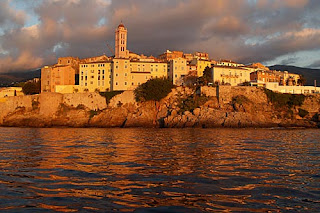
a beautiful island
 and awesome cheeses
 but they also have some ass kicking wines with authentic winemakers who pay ultimate respect to their terroir and vines.
This was a beautiful Sunday in Chicago and along home made sausages, we drunk 4 Corsican wines I brought back from home.
The program was 2 Patrimonio, 1 from Calvi and one from Porto Vecchio.


Not only they have Laetitia Casta

a beautiful island
 and awesome cheeses
 but they also have some ass kicking wines with authentic winemakers who pay ultimate respect to their terroir and vines.
This was a beautiful Sunday in Chicago and along home made sausages, we drunk 4 Corsican wines I brought back from home.
The program was 2 Patrimonio, 1 from Calvi and one from Porto Vecchio.


While decanting the 2 Patrimonio, we started with the 2008 Clos Culombu. A blend of 50% Niellucio, 30% Sciacarello, Grenache and Syrah. The nose is great with nice pure fruit on the nose. Pepper and garrigue notes with red fruits and a touch of blackberry comes along. There is a great energy on the palate with a nice lift on the finish. Very good structure. Served slightly above cellar temperature, it is a superb wine for summer.
The second wine was on the opposite spectrum. The 2004 Domaine de Torraccia Oriu (Porto Vecchio) is a blend of 80% Niellucciu and 20% Sciaccarellu. Fermentation is done with indigenous yeast and follows with a soaking from 15 to 21 days between 26 and 30°C with a finishing on “marcs”. The blend is aged in concrete tanks for 18 months, then at least two years in bottles. Brickish rim, masculine wine. Darker profile. Gamy nose. Slightly stewed fruit but enough acidity. Needs food. Long meaty finish. Overall a very good rustic wine which needs some air. Taste a little older than its 6 years. This Oriu cuvee is the top one for Domaine de Torraccia. The grapes are grown on the granitic soil.
Manual weed control with hoes, no chemicals, and harvesting the grapes by hand. The only treatment they use for controlling mildew in their certified-organic vineyard is bouillie bordelaise. The wines do not see any kind of wood.
We then moved on to the 2 Patrimonio, maybe the best know appelation from Corsica using mainly Niellucciu (must be at least 90%), a cousin of Sangiovese.
The 2007 Antoine Arena Morta Maio was simply beautiful. Antoine Arena is the star of Corsica. Doing everything as natural as possible, using absolutely no chemicals or fertilizers, only indigenous yeast, his wines always show great purity and depth. Here also, no wood at all is used but instead concrete or stainless steel tanks. This is 100% Niellucciu, young vines (replanted in 2001).
For such young vines, this is fantastic. Very sangiovese like with a lot of pure red fruits, dusty cherry. The tannins needs to soften up a little bit but give the wine its strcuture. Earthy with very good acidity. Bravo !
The last wine was a 2007 Yves Leccia Patrimonio. Yves Leccia left the family winery in 2004 to create his Domaine d'E Croce. Vines are around 20 years old and here also everything is made with respect to the soil. Schiste, calcareous and clay are the main types of soil. Here 10% of grenache complements the niellucciu. At this point, it needs more time than the Morta Maio. Lot of fruits, you can feel the potential is here but it will blossom in 4-6 years. Dark cherry with a very velvety texture. Some herbs with a nice mix of red/dark fruits. Overall, less acidity and a little darker profile than the Morta Maio. Very good as well.
Overall this was a pretty awesome lineup with all wines showing well. It is so nice to see well know producers not falling for new wood. Those wines all showed an outstanding purity along with a sense of place. This is all that we are looking for....
Subscribe to:
Posts (Atom)