Showing posts with label Champagne. Show all posts

Saturday, December 18, 2010

Because it's cold outside, let's drink some Champagne!

Ok, it is a freaking minus 89 degrees outside (who says people from the South always exaggerate?), so you'd think we would be in the mood to drink some good Madiran and Brunello? Err, well no. We were, as always in seems somehow, in the mood for some good Champagne.
A few friends, a perfectly done brandade de morue to go along (my wife nailed the dish) and 4 champagne. Yup, life is good.

The wines were tasting blind 1st and then, as usual, enjoyed with dinner.


1998 Henriot Champagne Brut Millésimé
Elegant and subtle nose with some green olives, lemon and yeast. Lively with a nice balance of autolysis character and fruit. This particular bottle was not showing many tertiary aromas. Really nice to drink and true to the style of Henriot. I feel Henriot is somehow underrated.


N.V. Jose Dhondt Champagne Blanc de Blancs Brut
Some candy like flavors on the nose with an oxidative character. It gives you the impression the wine was raised in barrels whereas only stainless steel is used here.
Barely bubbly, rich honey, round and rather flat.
I think the bottle might be off...

2002 Henri Goutorbe Champagne Special Club
Rich and powerful nose. I thought this was a blancs de noir.
Honeyed, some red berry fruits and white chocolate on the palate, it needs time for the acidity to finally show up. A nice light saltiness refresh the finish.
Definitely from a warm vintage but given some time in the bottle, this should show really well.
I'd love to try again in 10 years.
The 2002 is 70% Pinot Noir and 30% Chardonnay. The wine was fermented in stainless steel and malolactic fermentation was blocked. Fruit is coming exclusively from Ay.


1996 R. & L. Legras Champagne Cuvée St. Vincent Blanc de Blancs Grand Cru
Lovely nose, mineral. Floral and plenty of citrus and pear. Leesy as well with white chocolate
High acidity and full of energy, this tastes really young. After having the 1990 twice, I can tell this is a cuvee that can age 20 years easy and benefits from it. This cuvee is made only in special years.


I'm still thirsty.....

Wednesday, October 27, 2010

At school with Anselme Selosse

Rendez-vous was given: Caves Legrand, October 19th. For the second time this year, I was going to spend some time with one of the most interesting winemakers you can find: Anselme Selosse.
Anselme started with a quick introduction on his domain. Located in Avize, he took over his father after his studies in Burgundy which he says had an impact on the way he's working. He conducted a biodynamic agriculture from 1995 to 2001 and quit because he wanted more freedom while still respecting the vines.

Interestingly, when asked about the people who influence him he mentions 4 names:

-Didier Barral from Faugeres because of the way he brought an entire ecosystem in his vineyards
-Sylvain Pitiot from Clos de Tart
-Claude Bourguignon (soil expert)
-Jean Marie Pelt, French botanist who founded the European Institute of Ecology


When the date of this dinner was set up, Anselme disgorged (last March) 6 bottles of his 2003 vintage. Because he wanted to show us the impact of the dosage, after disgorging those 6 bottles he used a different dosage for each of those: no dosage, 0.06 cl, 0.12 cl, 0.18 cl, 0.24 cl and .30cl.


One important thing to realise is that even for the highest dosage here, we are still in the Extra-Brut category and Selosse Champagnes are always very low in dosage.

So here we go on this dosage class, just like Anselme did when he choosed what he was going to do with his 2003 vintage: try different combinations and see the one(s) with the most balance.

For my part, I really enjoyed the 1st one (no dosage) and the 4th one (0.18cl). The last 2 I thought we too heavy and were almost sticking to your palate (even though once again it is still a very low dosage). The 2nd and 3rd were not bad but you could sense something was missing.
Anselme eventually picked the 4th one for his 2003 vintage (o.18cl).

It was really interesting to see the impact of the dosage. To me a few things stood out:
-It seems like he has an impact on the oxidative character: the more dosage you have, the less oxidative character you feel (white chocolate, quince) and the less dosage you have, the more oxidative character you sense (curry notes).
-Also, it looks like it has a light impact on the effervescence: it is less bubbly with low dosage.

Again those are my impressions on those very particular bottles. It would be interesting to check this out on other producers.

Then, we were treated with 5 different Selosse vintages: 2005, 2003, 2002, 1999 and 1998.
His vintage always sees 50% of new wood and comes from 2 parcelles in Avize (100% Chardonnay): Chanterelle (oriented East) and Maladri (Coteau, oriented South). All the champagnes were disgorged the day before the dinner and were not dosed.

The 2005 showed some butter and light vanilla. Very Burgundian, got better with air gaining balance. Needs time.

The 2002 showed honey and spices along exotic fruits.

The 1999, wine that I've been lucky to have a few times now, is a very solar champagne (14.5%!). It is quite opulent, quince but again some minerality appears with air and give freshness to the wine.

The 1998 starts to show truffle notes with a hint of exotic fruits.

There's also in every wines a light and refreshing bitterness on the finish. Anselme mentioned that this is partly due because of the slow pressurage he's doing. Overall I believe, but this is personal, that his vintage Champagnes need time to acquire the perfect balance and to allow the mineral spine, so precious to Anselme and true to Avize, to reveal itself.

Another unforgettable moment with Anselme.

Friday, September 3, 2010

Selosse and Huet: masters of their domain

To start my Bday dinner, my wife prepare some pasta dough and created some Lemon ravioli. This is a great dish and we needed 2 whites to go along. A friend brought the 1996 Huet Le Mont Sec and I opened a Selosse Initiale (disgorged nov 2007).


I was super excited to try an aged Huet as all the ones I had were only 2 to 4 years old. This turned out to be a great experience. The Huet showed a rich nose with honey, pumpkin, quince with hint of flint. Dry, borderline of having a touch of RS, the high acidity gives the wine plenty of energy in spite of its fatness. Lemony honey with the slightest hint of oxidation. What I loved was the Chenin character.

The Selosse, as always was a unique experience. This bottle was more oxidative than the last one I had. The nose was stunning and complex. The oak is so well used. You feel like drinking a white Burgundy (with a hint of Jura in this bottle !). There's a strong minerality associated with ripe fruits.

Both wines were perfect with the lemon raviolis. But even more interesting maybe was that the 2 wines showed similar characteristics: oxidative notes, richness, high acidity and minerality. I would not have thought about it before but the luck of drinking those 2 wines side by side opened my eyes.

I will always keep learning....

Friday, August 6, 2010

A few days of decadence

Finally escaping Chicago's heat for a few days, we headed to the Hamptons and NY to visit some friends.
Lot of fun and great company and on top of that great wines !

First gem was a magnificent 1999 Philipponnat Clos des Goisses Rosé. I believe 1999 was the 1st ever vintage for the rosé. Coming from a chalk soil, this is the lightest rosé I have ever seen colorwise. It barely have any pinkish hue. Brine, see breeze, almond with subtle red fruits. It is very elegant and intense on the palate at the same time. A great Champagne, still a little young in my opinion.
Then a battle of syrah and shiraz followed. The 1999 Côte Rôtie La Mouline and 1999 Côte Rôtie La Turque battled agains a 1994 Penfolds Grange. Ok, ok, for purist it is a battle of Shirah/Viognier against Shiraz/Cabernet.
Well, at least for me, it was not even close....While I thought the Grange showed a nice balance and interesting complexity but a little too ripe. On the other hand, La Mouline opened faster than the Turque (more viognier in the Mouline) but after 2 hours, La Turque won me over with nice bacon fat notes and a finish which lasted almost 3mn. Very impressive and it was nice to see the oak was already digested even if La Turque showed some hint of new oak for the first 30mn.


Next day, the honors were reserved for Bordeaux. A nice, austere and structured 1982 Lynch Bages opened the dinner. I really enjoy their style, never over the top. I was skeptic about the 2000 Cos d'Estournel which followed. But from the very 1st sip, I loved the Asian spices and smoky notes. Pure fruit with very good acidity, especially for 2000, it's slowly entering its drinking window.

We finished with a great 1990 Domaine des Baumard, Quarts de Chaume. It was an explosion of honey, orchard fruit backed up by terrific acidity. Very good wine.


Thanks God the cold I caught was only after all this drinking...!

Great friends, great wines in a beautiful place....Perfect weekend !

Wednesday, July 7, 2010

Champagne Blind tasting

With temperatures approaching 100F, we all gathered home to taste blind some Champagne. Great tasting, fun night. And thanks God we did not choose Napa Cabs on a day like this.
Note: Flower day during the tasting.

A few generic info on Champagne: located very close to Paris (150Km)and spread over 5 departments: Marne (67%), Aube (22%), Aisne, Haute-Marne and la Seine-et-Marne.

We officially differentiate 4 main zones: Montagne de Reims, Vallée de la Marne, Côte des blancs, Côte des Bar.
17 villages are designated Grand Cru and 44 Premier Cru.


Before starting, we tried 2 wines, tasted double blind:

2007 Kanonkop Estate Pinotage (Stellenbosh, South Africa): Oaky and a touch of heat on the nose (as well as on the finish). Med tannins, soft. Ripe cherry, blackberry and plum. Spices.
Ok but too much oak and alcohol.
Initially thought an Aussie shiraz and then went for Argentinian malbec...
2006 Pierre-Marie Chermette Moulin-à-Vent Les Trois Roches: Purplish. Ripe fraise des bois, blueberry and cherry. A little candy like and extracted.
Correctly guessed Chermette, Moulin 2006 as this is a wine I had last Feb.
Not my cup of tea as I found it a little too extracted and fruit fwd.

Back to Champagne now:
We went through 2 flights, all tasted blind.

1st Flight


Varnier-Fanniere Champagne Brut Blanc de Blancs Cuvée St. Denis (Avize)

Wow...Very complex with interesting savory notes mixed with minerals.
Powerful, lots of depth, brioche and fresh dough with a long finish.
I though this was 100% PN and this is 100% Chard!...Vines are 65 years old and come from a single vineyard in Avize called “le Clos du Grand Père”. A spectacular champagne for the price.
Disgorged 9/5/2007

L. Aubry Fils Champagne Brut 1er Cru (Petite Montagne de Reims)


Oxidative style, hint of butter and truffles on the nose. Very yeasty and lemon notes, the finish is a little heavy. Not bad but I'd like to see more acidity.
Disgorged Dec 2009.
Meunier 60%, Pinot noir 20%, Chardonnay 20%.


Billiot Fils Champagne Brut Réserve (Ambonnay)


Initially tight, it really blossomed with air.
Although this cuvee do not see any oak, you have the impression of a little bit of oak on the nose. Then some lemon and green apple, yeast. Round and vinous but very good acidity, light coffee and brioche notes.
Disgorged June 24th 2009.
Needs a 2-3 years to come around.


2nd Flight


2000 Drappier Champagne Grande Sendrée (Cote des Bar)

Tight but with a lot of substance underneath. Light oak, powerful and full body, this clearly needs time.
I had many different vintages of the Grande Sendree, but never that young, and this will only gain complexity and depth with more years.

2000 Marguet Père et Fils Champagne Grand Cru Brut (Ambonnay)

Man, talk about an interesting nose: tabasco, cheese cracker, butter. Big.
Oxidative style, opulent palate. Majority of PN.
Not really my style as this is too big and no zip.

N.V. Pierre Peters Champagne Blanc de Blancs Brut Cuvée de Réserve (Le Mesnil Sur Oger)

Well unfortunately this bottle was probably off. A few people among us already had several times this champagne and none of us recognised it. No Mesnil character, very fruit forward, smoky, it lacks the depth and elegance that Pierre Peters always have.


Overall a very good champagne tasting with different styles among them. I'm really bummed about the Peters which is one of my favorite.
A very good surprise with the Varnier-Fanniere, a really complex NV champagne at a very good price.
Quite a few champagne with an oxidative style. I remember listening to Selosse saying that this is old school champagne, like they were doing 100 years ago. This is to have good acidity and fruit to absorb the oak.
Also, interesting to note that, as my wife said, that among those champagnes, none were showing floral and mineral notes (although we had wines from Avize and Le Mesnil).

Wednesday, May 26, 2010

Some "feels good" wines

We went back home for 3 days and he was great to be in sunny Paris. After having lunch with a good friend, I realised how I missed the French bistrots where you can eat some simple but delicious food along nice wines without having to pay $80 for the bottle.

So to go along the kidneys, we choosed a 2008 Domaine Richaud Cairanne. Marcel Richaud is a famous name in the Cotes du Rhone appelation. A few times his wines have been refused by the INAO because of a lack of tipicity. Hum....lack of tipicity? I think they're were just too good and different from many crappy CdR so the INAO had to refuse them. Anyway, Marcel Richaud is a fantastic winemaker respecting the terroir and grapes. Manual harvest, indigenous yeast, no acididification or chaptalisation...you get the picture. This 2008, while young (obviously) was perfect along the kidneys and entrecote. Totally open and showing very well. Floral and mineral on the nose with garrigue and licorice. Mainly dark fruits and earthy notes. It's already balanced and will only improve with time. The 14.5% are well integrated. You want to taste where the wine comes from and with the 1st sip you know you are in Provence.

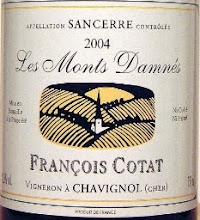
Along the turbo for dinner, a superb 2008 Francois Cotat, Les Monts Damnes was sacrificed. I say sacrificed because Francois' wines needs 10 years. But boy, it's too hard to wait that long! As predicted, this was really tight. Wet rocks and cassis leaf. Powerful on the palate. Not much fruit right now but I love the acidity and light mineral notes. As usual it is never a disappointment with Francois!This needs to go to sleep for a few years.


Different register the next day with a Jérôme Prévost La Closerie Les Beguines (LC07) and a 1999 Clos Rougeard.

Jérôme Prévost started doing his champagnes in Selosse's cellar because of a lack of...cellar! His 1st vintage is 1998 as he was previously selling his grapes.
He harvests at a high degree of ripeness in order to avoid chaptalization and fermentation takes place with indigenous yeasts in 450- to 600-liter oak barrels. While never a declared vintage champagne, he uses grapes from a single year and the code on the bottle (LCxx) indicates the millesime. The 2007 is a great extra brut. 100% pinot meunier from old vines, there's not really one fruit coming out but instead a complex array of aromas. Impeccable balance, it made me think of a white burgundy with a touch of cognac oak like.You can definitely see the Selosse influence here even though this champagne is not as vinous. Took a little time to open up. Might be a good idea to decant it for 20-30mn.

The Clos Rougeard was no surprise: it was just awesome. A little decanting was in order and this Clos Rougeard was in a soft spot. Intoxicating and complex nose with a touch of cedar, lots of tobacco, a touch of bell pepper. All that is backed up by a good and fresh fruit. Round, it shows more earthy notes on the palate with a long finish. The balance is where it should be with a nice acidity. It somehow reminded me a little bit of a Bordeaux with more acidity and earthy notes. Simply delicious and à point.


How can you not feel good after wines like this?!

Wednesday, March 3, 2010

An afternoon with Anselme Selosse

A reflexion on a visit to Anselme Selosse back this January.


AN AFTERNOON SPENT WITH THE MASTER: ANSELME SELOSSE - Avize (1/14/2010)

Thursday January 14th. 2.30 PM. After a snowy day in Champagne, the sun is shinning again. Shops are closed, no traffic, this is a quiet day in Avize…so quiet that I can hear my heart pounding: I’m finally going to meet Anselme Selosse. I read a lot about him, heard a lot and enjoyed his wines a lot as well…Am I going to be disappointed after such anticipation? Well….all I can say is WOW! The first thing you notice when you enter in the small office of the house is a bunch of books: “La philosophie du jardinier”, books on the Tao, on geology… Calling Anselme a winemaker would be wrong: he’s much more than that. Call him an artist, a philosopher, a poet…and oh yeah he also makes wine.
Spending 3 hours with him is hard to transcript. There is too much information and the exchange is constant. Anselme believes in letting the terroir speaks and intervene as little as possible in the vineyard. Each crus (Avize, Le Mesnil, Cramant, Oger, Ay, Ambonnay, Mareuil) , each parcelles (47), are unique and express themselves in a different way.
Least you can say he is not a big fan of biodynamic movement. He simply wants to let the soil do the work and want us to be able to taste the uniqueness of each sites in the bottle.
For Anselme, a wine is influenced by “l’inné et l’acquis” or if you want "nature versus nurture" or “skills versus knowledge”. L’inné for the wine is the soil, this is what he gets from the terroir. L’acquis is the vintage.
His wines are raised in barrels (like it was common to do before 1959 in Champagne) which are changing every year. Indeed the size and type of oak will depend on the millesime, on the peeps of the grapes etc... Then the juice goes into the cellar for up to 7.5 years.
After the tour of his new installations, the new press, and his cellar, Anselme looks at us and with a malicious tone asks us: “So, what are we trying today?” Oh oh…can I tell him let’s try all your wines! He loves to have you try some wines which are not released or experiments he made because this is Anselme: believe, respect and try. Sometimes it works out, sometimes it doesn’t (like the noir de blanc (!) he tried to make).
We finally decide to try the 1999, 2002, Le Mesnil 2003, the rose and “il etait une fois”.

At the end of the tasting, I tell Anselme that I came to see him hoping to understand a little better his wines but really, I think I’m even more puzzled now than before. He smiles and says: “that was exactly what I’m trying to achieve”. Well said Mr Selosse and thank you for 3 hours that I will never forget.


2003 Jacques Selosse Champagne Blanc de Blancs Les Carelles

100% Chardonnay from the site called Les Carelles in Le Mesnil.
I'm not sure how this will be released.

Fantastic wine with some apricot, quince, cooked orchard fruits. A lot of acidity and a champagne with a huge density. Some nice honey notes on the palate completes a very complex and balanced wine.

1999 Jacques Selosse Champagne Grand Cru Blanc de Blancs Brut

100% chardonnay from Avize.
Disgorged early feb 2009.
Boy oh boy ! Biggest champagne I have ever tasted but still balanced and fresh thanks to a strong minerality.
This wine already starts to show truffles and mushroom notes along with persimmon and grapefruit notes.
As Anselme was noting, un "vin sudiste" and ripe even though it was hard to tell this was 14.2%.
He tried to have a derogation form the INAO to not add any sugar after the 1st fermentation in the liqueur de tirage but this was rejected...
I would wait a few years to open this and this is a champagne which absolutely needs food !

2002 Jacques Selosse Champagne Grand Cru Blanc de Blancs Brut

100% chardonnay from Avize.

Disgorged in front of us and will be released in 2012.
Hard to taste as this was just disgorged and no dosage yet. Anselme will decide in 2 years how to dose the wine.
As always not much bubbles but a gorgeous nose with a lot citrus fruits, orange notes. A refreshing light bitterness on the finish (think roots) and like many Selosse wine, a strong mineral backbone.
To my taste, this wine does not need any dosage at all but who knows in 2 years?
Anyway, a terrific champagne in the making and already very complex.

N.V. Jacques Selosse Champagne Rosé

For this rose, Anselme uses pinot from Egly-Ouriet.
This bottle was mainly using 2002 grapes.

I loved the nose with a nice minerality and small red fruits. Upon opening a touch of iodine, sea water. Somehow a delicate wine compared to the other Selosse.
The palate is a little less complex but this needs time in the glass.

N.V. Jacques Selosse Ratafia de Champagne il etait une fois

Ratafia de Champagne, 100% chardonnay.

For this sweet wine, Anselme uses 4 small barrels of chardonnay that he leaves outside for 6 years and then adds fine de champagne. 15% alcohol and close to 168g/l of sugar.
I just loved this juice. Orange, spices, raisins with a crazy long finish on walnuts.
Not heavy, not too sweet, nice balance.
A perfect example of how Selosse have fun and always tries to do different things.

It is really hard to understand Selosse champagne. Very vinous, not very bubbly. Rather big, oxidative style, you need to spend some time with it in the glass to appreciate.
It's always difficult to put words on the aromatics and flavors. You have to take those wines as a whole and go for it.
But you always have this freshness thanks to the strong minerality and whether you like Selosse or not, it never leaves you indifferent.

Thank you mr Selosse.